Contact Info

 Zoho Inventory in Sweden
Is Zoho Inventory suitable for a Swedish company?
Zoho Inventory suits a Swedish webshop, wholesaler or brand that needs reliable stock across one or a few warehouses, batch or serial tracking, purchase orders and shipping, without the weight of a full ERP. Swedish VAT on invoices and the statutory books are handled in Zoho Books, Fortnox or Visma, not in Inventory. I check the fit, carrier and channel options and the accounting link remotely, as an independent consultant.
Last reviewed by Vikas Saroj
Swedish product companies often grow through a webshop first, then add retailers in Sweden, Norway and Finland, a marketplace or two and a third-party warehouse. Stock that was easy to track in the webshop's admin becomes a daily argument: which channel sold the last unit, what is on the way from the supplier and what the goods really cost once freight and duty are added.
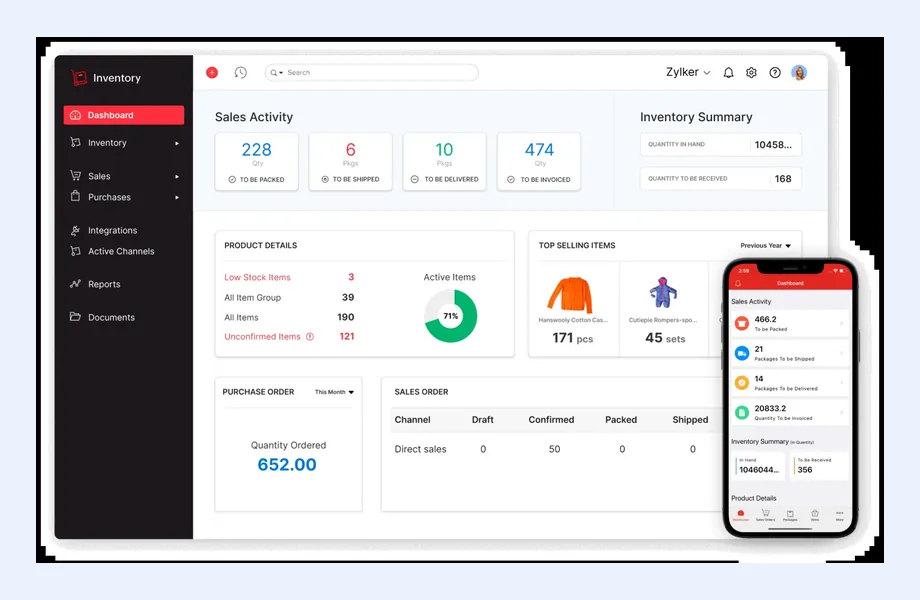
Zoho Inventory can bring orders, stock and purchasing into one place, provided it is set up around how your goods actually move. I work remotely with Swedish companies to test whether Inventory fits, design the item and warehouse structure, and define how it connects to the webshop, carriers and the accounting system that holds your Swedish books.
 What I Do
Getting Zoho Inventory right in Sweden is mostly about structure and boundaries, decided before items are imported.

A comparison of your order volumes, channels, warehouses and tracking needs against what Zoho Inventory does well, with a clear recommendation if an ERP or a warehouse system is the better route.

SKU rules, variants for size and color, bundles and gift sets, units of measure and reorder points, designed so the webshop, retailers and the warehouse all mean the same thing by an item.

Warehouses for your own stock room, a third-party logistics provider and any consignment stock at retailers, with transfer rules and a decision on who confirms what was shipped.

Purchase orders, receiving and a method for adding freight, customs duty and handling fees to item cost on goods from outside the EU, agreed with your accountant before go-live.

Connections to the webshop, marketplaces and shipping, checked against what Zoho supports for Sweden today, with a fallback through a shipping platform where a Nordic carrier is not covered.

A defined link between Inventory and Zoho Books or your Swedish accounting package, covering invoices, purchase bills, stock value and the reports your accountant needs at period end.
How I Work
Follow goods from order to delivery
 Map channels and order sources
Walk the receiving and picking flow
List tracking and costing needs
Review the accounting setup
Map channels and order sources
Walk the receiving and picking flow
List tracking and costing needs
Review the accounting setup
Items, warehouses and links
Clean and load the item master
Configure warehouses and transfers
Connect webshop and carriers
Agree landed cost method
Counted stock, live orders
Full stock count before go-live
Parallel test with real orders
Train warehouse and office staff
Reconcile stock value with finance
Zoho Inventory is designed for companies that buy finished goods, store them and sell them through several channels. In Sweden that describes a wide range of businesses: online brands in fashion, home and outdoor, distributors of tools and spare parts, importers of food and drink, and technical wholesalers selling to installers.
It tends to fit well when:
It fits less well when you assemble or manufacture products with multi-level bills of materials, run a large warehouse that needs bin-level task management and scanning workflows, or operate several legal entities that trade stock with each other. In those cases an ERP such as Odoo or Business Central, or a dedicated warehouse system, is usually the better base. I make this assessment with your own volumes and processes, not a generic checklist. The product-level overview is on my Zoho Inventory consulting page, and the wider choice of Zoho apps for Sweden is on Zoho consultant Sweden.
Many Swedish online brands outsource storage and shipping to a third-party logistics provider while keeping a small stock room for samples, returns and trade orders. Zoho Inventory can treat each as a warehouse, but the design must say which system is the master for stock levels at the provider and how shipments are confirmed back. If the provider has its own warehouse system, an integration or a regular file exchange carries orders out and confirmations in. I write that exchange down field by field and agree it with the provider.
Traceability needs depend on what you sell:
Which product rules apply to your goods, for example labeling or recall duties, is for your quality lead or advisor to confirm. I make sure the item setup records what they require. Before go-live, a full stock count gives the opening balance, and the count method is agreed with your accountant so the value matches the books. Where on-site checklists for returns or quality inspections are needed, a small app can help; see Zoho Creator in Sweden.
Swedish companies buying from the EU receive goods without customs formalities, but goods from Asia, the United Kingdom, Norway, the United States or elsewhere pass through customs, usually handled by a freight forwarder. Customs duty, freight, insurance and handling fees then arrive on separate invoices, often weeks after the goods. If those costs are not added to the items, margins in reports look better than they are.
Zoho Inventory offers a way to allocate additional costs to received goods, but availability can depend on edition and region, so I confirm it with Zoho for your account. The method itself is agreed with your accountant:
Purchase orders in foreign currencies, mostly euros, dollars and sometimes yuan, are converted using rates finance approves. Supplier lead times and minimum order quantities set reorder points, so purchasing is planned rather than reactive. If customs documentation or supplier compliance needs a structured workflow, I scope that separately. For a deeper look at stock processes across platforms, see the inventory and warehousing solution page.
A Swedish seller typically already runs a webshop on Shopify, WooCommerce or a Nordic e-commerce platform, and may also sell through marketplaces. Zoho Inventory offers integrations with several webshop platforms and marketplaces, but the list is region-specific and not fixed. I verify what is on offer for a Swedish account today and test it with real orders, rather than relying on a features page.
The decisions that matter:
Customer questions about orders and deliveries are often handled in a help desk linked to the same order data; see Zoho Desk in Sweden. For sellers whose ads drive webshop orders, linking stock to campaigns avoids paying for clicks on sold-out items.
Zoho Inventory is not an accounting system. Invoices, purchase bills, VAT and the general ledger live in Zoho Books when the two are used together, or in your Swedish accounting package through an integration. That boundary matters in Sweden because your accountant relies on the ledger for VAT returns and SIE exports.
Two common designs:
VAT treatment of each sale, whether domestic, to another EU country or for export, is set in the accounting system according to your accountant's rules. Inventory supplies accurate quantities, prices and customer details.
An ERP becomes the better choice when you start manufacturing or kitting at scale, need advanced warehouse management, run several companies that trade stock between them, or need stock and finance in one ledger without integration. My ERP consultant Sweden page covers that path, and the Sweden hub has market context. All work is delivered remotely in English during Swedish working hours.

Tell me about your business and current systems. I’ll suggest the most sensible first step.
Book a Consultation
Not sure which ERP you need?
Share your business requirements with me and I will help you understand the right process, architecture and platform before implementation.
FAQ
Often, yes. Zoho Inventory integrates with several webshop platforms and marketplaces, but the list depends on region and changes over time. I confirm what works for a Swedish account, test it with real orders and plan an alternative, such as a connector or shipping platform, where a direct integration is missing.
Zoho Inventory records sales and purchases, but VAT reporting and the general ledger are handled in Zoho Books or your Swedish accounting package. Your accountant decides the VAT treatment of each type of sale, and I make sure Inventory passes the data the accounting system needs.
It is possible through an integration, but it needs careful design. Invoices, purchase bills and stock value must flow consistently, and stock value should be reconciled between the systems every period. I specify that integration and test it with your accountant before go-live.
Zoho Inventory has a way to allocate additional costs to received goods, subject to edition and region, which I confirm with Zoho. Your accountant decides which costs belong in stock value and how they are spread, and I configure the process to follow that method.
When you manufacture or assemble at scale, need detailed warehouse task management, run several companies that trade stock with each other, or want stock and finance in one system. In those cases I compare ERP options, such as Odoo or Business Central, against your requirements.
Every business is different. Share where you are today and what you want to fix, and I’ll tell you honestly whether and how I can help.
Book a Consultation
Insights
 Book a Consultation
Book a consultation to talk through your processes, systems and goals. I’ll reply with practical next steps - no obligation.