Contact Info

 Zoho Inventory in South Africa
Is Zoho Inventory right for a South African wholesaler?
Zoho Inventory suits a South African wholesaler or online seller that needs stock across several branches, transfers between provinces, serial or batch tracking, imports with landed cost in rand and orders from a webstore or marketplace. VAT tax invoices come from Zoho Books or the accounting system your practitioner relies on. Manufacturing, many companies or bin-level warehousing usually call for an ERP instead.
Last reviewed by Vikas Saroj
A South African distributor might run a main warehouse in Gauteng with branches in the Western Cape and KwaZulu-Natal, each keeping its own stock list in a spreadsheet or a separate copy of desktop software. Head office then spends days reconciling what is really on the shelves.
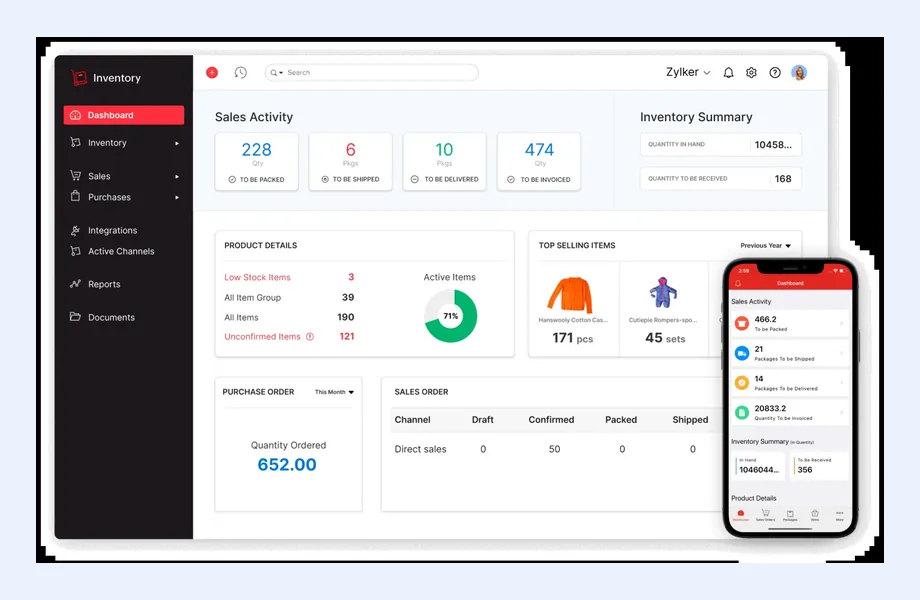
Zoho Inventory brings items, warehouses, transfers, serial and batch numbers, purchase orders, packages and shipments into one cloud system, linked to Zoho Books for the ledger. It can also take orders from some online stores and marketplaces.
I work remotely as an independent consultant, mapping how stock moves through your business and judging whether Zoho Inventory is deep enough before you commit.
 What I Do
The focus is getting stock records to match the shelves in every branch, and keeping them that way.

Warehouses for each branch and storeroom, transfer orders between them, and rules for who can sell from which stock, agreed with branch managers before setup.

A cleaned item master with codes, units, reorder levels and serial or batch tracking where warranties, recalls or expiry make it necessary.

Landed cost design for goods arriving through the ports, spreading freight, duties, clearing fees and insurance across items in rand, signed off by your accountant.

Confirming which connectors exist for your webstore, marketplace and courier services, testing them with real orders and planning returns before go-live.

Designing how orders and shipments become VAT tax invoices in Zoho Books, Sage or Xero, so tax documents always come from the accounting system.

Agreed steps for receiving, picking and dispatching when power or connectivity fails, and a catch-up routine so records are complete once systems return.
How I Work
Follow stock from supplier to customer
 Map receiving and dispatch
List branches and channels
Review item data
Note outage workarounds
Map receiving and dispatch
List branches and channels
Review item data
Note outage workarounds
Configure and prove with real data
Warehouses and items loaded
Transfers tested end to end
Landed cost checked
Connectors trialed
Opening counts verified
Make the counts hold
Cycle counts scheduled
Variance reviews monthly
Branch users coached
Returns flow refined
Multi-branch stock is where South African wholesalers feel the most pain. Each branch wants to protect its own stock, customers call the nearest branch and expect it to see availability everywhere, and trucks move goods between Gauteng, the coast and regional towns every week.
In Zoho Inventory I design this with:
The biggest risk is not the software but timing: if a branch records receipts a week late, central stock is wrong for a week. I agree same-day recording routines with branch managers and test them before go-live. The global Zoho Inventory page covers the product in general.
Many South African traders import, with goods priced in dollars, euros or yuan and arriving through Durban, Cape Town or another port. The true cost of each item includes ocean freight, insurance, customs duty, clearing agent fees, port and transport charges, and these invoices arrive at different times from different parties.
How I set this up:
Before go-live I rerun a recent shipment through the new setup and compare item costs with what finance calculated by hand. If they differ, we find out why before margins and pricing depend on the numbers. For the broader multi-currency question, see ERP for multi-currency.
Distributors of electronics, tools, appliances, solar equipment and spare parts carry warranty obligations, and customers return goods with claims. Without serial numbers, you cannot tell whether the unit came from you, when it was sold or whether the warranty still applies. Consumer protection rules also shape how returns must be handled for some sales; your legal advisor confirms what applies.
What I set up in Zoho Inventory:
Where warranty claims become service tickets, they can flow into Zoho Desk with the serial number attached. Getting serials into the system at receiving is the step that decides whether the rest works; I spend time on that routine with warehouse staff.
Many South African wholesalers now also sell online, through their own store, a marketplace or both, and ship by courier. Each channel needs stock levels that are accurate enough to avoid overselling.
Then the outage question. When power drops, scanners and printers stop and the cloud system may be unreachable. Routines I agree with warehouse teams:
The system integration page covers how connectors recover after downtime.
Zoho Inventory raises sales orders, packages and shipments; the VAT tax invoice is a ledger document. When Zoho Inventory and Zoho Books share an organization, invoices are created in Books from the order. If your ledger is Sage or Xero, the integration has to create the invoice there with the right VAT codes and customer details. What a valid tax invoice must contain, and how VAT applies to each item, is for your tax practitioner to confirm.
Zoho Inventory reaches its limits for some South African businesses:
In those cases I compare Odoo, ERPNext and Business Central against your written requirements. See my South Africa ERP consultant page and the best ERP for distribution comparison. Work runs remotely in English, with warehouse visits only by arrangement. The South Africa overview has the wider context.

Tell me about your business and current systems. I’ll suggest the most sensible first step.
Book a Consultation
Not sure which ERP you need?
Share your business requirements with me and I will help you understand the right process, architecture and platform before implementation.
FAQ
Yes. Each branch becomes a warehouse, transfers move stock between them with a confirmation on arrival, and users can be limited to their own branch while sales staff see availability everywhere. The setup only stays accurate if branches record receipts and dispatches on the same day.
Zoho Inventory offers landed cost features that spread freight, duties and fees across items in a shipment. Confirm the feature is in your edition. Your accountant decides the treatment of import VAT and exchange rates, and I test the setup with a past shipment before go-live.
It is possible through an integration that creates invoices and bills in that ledger, but it adds complexity compared with Zoho Books, which shares an organization with Zoho Inventory. I compare both routes, including who maintains the integration and how errors are caught.
The cloud system keeps running, but your devices and connection may not. Backup power for key equipment, mobile data as a fallback and a paper picking routine keep dispatch moving, and a same-day catch-up checklist brings the records back in line.
Every business is different. Share where you are today and what you want to fix, and I’ll tell you honestly whether and how I can help.
Book a Consultation
Insights
 Book a Consultation
Book a consultation to talk through your processes, systems and goals. I’ll reply with practical next steps - no obligation.